
History
A stone house. Many lives.
The house was built in 1883 for a Lowell machinist, bought in 1887 by a lawyer whose family held it for thirty-eight years, divided into apartments, run for nearly half a century as a rest home, foreclosed, and since 2011 lived in and restored as a private home.[sources]
These pages keep to what the records show. Every statement carries a small [source] link to a research note; where the evidence is thin or contradictory, the page says so rather than smoothing it over.

Then and now
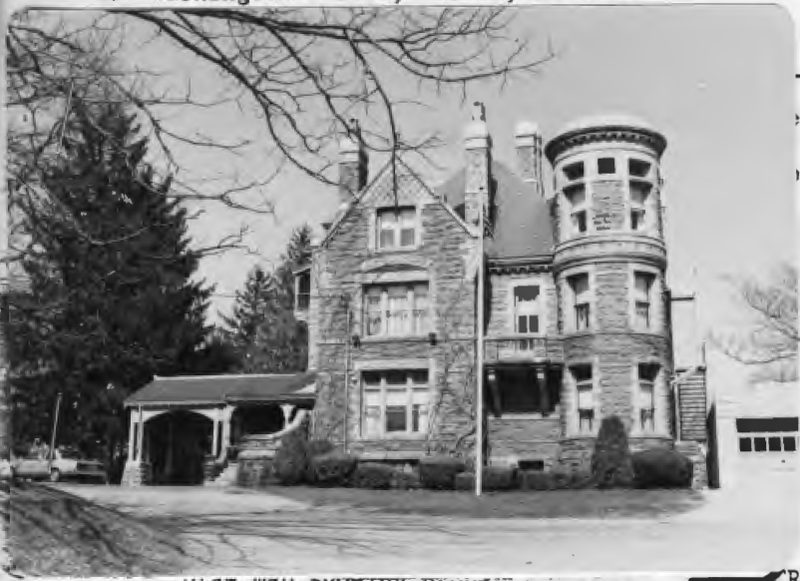
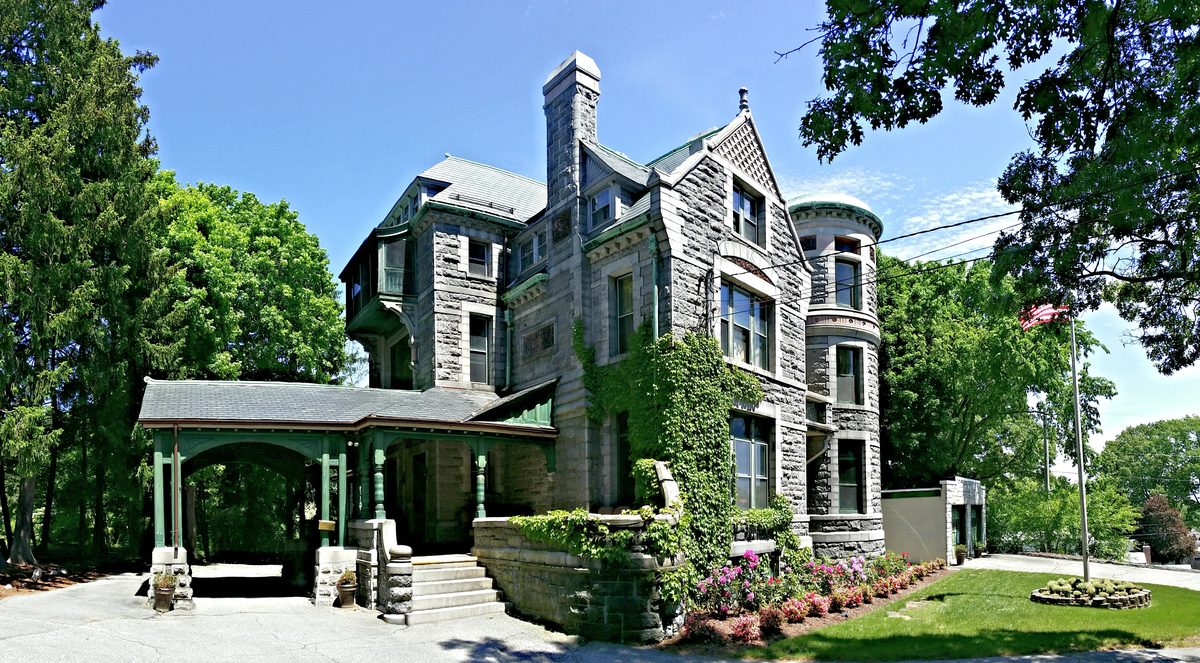
Six eras
- 1to 1882Before the houseBelvidere was Lowell’s hillside of merchants’ and manufacturers’ houses above the Concord River. Between 1880 and 1882 a Lowell machinist assembled three parcels on Fairmount Street into one building lot.
- 21883–1887Making the estateThe stone house went up in 1883, the year carved on its sandstone plaque. Four years later its builder sold it, subject to four mortgages, to the lawyer whose name the state inventory still uses for the property.
- 31887–1925The Bonney and Lilley householdsArthur and Emma Bonney, their daughter Clara, her husband Judge Charles S. Lilley, and the granddaughter who inherited the house: thirty-eight years in which the family’s weddings and funerals were held in these rooms.
- 41925–1957Twentieth-century transitionsThree owners in thirty years. The deeds record the sales and the division of the land; what daily life in the house was like in these decades is not yet documented.
- 51957–2004The Battles HomeFor nearly half a century the house was a rest home run by a Lowell charity founded in 1901. It is the period most living people remember, and the one the archive documents least.
- 62004–todayVacancy and recoverySale, foreclosure, two empty years, and since 2011 a private home under continuing restoration — open to the neighborhood one night each year.
Six milestones
- 1880–1882Abel T. Atherton assembles the hillside lot
- 1883The stone house is built
- June 1883The estate’s stable is published — Merrill & Cutler, architects
- September 1887Sold to Arthur P. Bonney
- April 1891Clara Bonney marries Charles S. Lilley at her father’s house
- 19 July 1894Clara Bonney Lilley dies; an infant daughter survives her
Chapters
Read the building
Tower, porte-cochère, rock-faced ashlar, carved sandstone and stained glass — what the 1981 survey saw, and what you can see from the street.
The Battles Home, 1957–2004
A Lowell charity founded in 1901, a rest home for about eleven residents, and the period the archive documents least.
The Bonney Witch
A monument at Lowell Cemetery, four lives connected to this house, and a Halloween legend — kept carefully apart.
People
- Abel T. Atherton — The Lowell machinist who assembled the lot and built the stone house in 1883.
- Otis A. Merrill — The Lowell architects of the estate’s stable (1883) — and possibly, but not demonstrably, of the house.
- Arthur Perkins Bonney (1828–1896) — Owner from 1887 until his death; the man whose name the state inventory gives the house.
- Emma Augusta (Call) Bonney (1828–1892) — Mistress of the house from 1887 until her death in 1892.
- Clara (Bonney) Lilley (1855–1894) — The Bonneys’ only child, married in the drawing room in 1891; her funeral left from the house in 1894.
- Charles Sumner Lilley (1851–1921) — Bonney’s son-in-law and successor in the house, where he lived from 1896 until his death in 1921.
- Clara Bonney (Lilley) Dunbar (born 1894) — Bonney’s granddaughter and heir, married at the house in 1917; the "Bonney L. Dunbar" who sold it in 1925.
- Charles Brooks Stevens (1865–1949) — Owner from 1925 to 1944; a Tewksbury textile manufacturer.
- Grace L. Murphy — Owner from 1944 to 1951, with her husband Thomas J. Murphy.
- The Battles Home — The Lowell charity that owned and ran the house as a rest home from 1957 (or 1956) until 2004.
How we know
The spine of this history is the chain of deeds at the Middlesex North Registry of Deeds (1880 to 2010), the 1981 state survey form, and digitised issues of the Lowell Sun from 1893 to 2011. Each statement on these pages is tied to a numbered research note; the notes record the source, how confident we are, and what still needs checking.
Three grades appear beside events: Documented (an inspected primary record), Attributed (a reasoned reading of secondary or partial evidence) and Unverified (one party’s report). Folklore is told on its own page and labelled as such.
Corrections so far. The 1981 survey says Bonney’s daughter outlived him; contemporary newspapers show she died in 1894, two years before her father, and that the house passed to his infant granddaughter. The 1883 journal plate long cited as the house by Merrill & Cutler turns out to show the estate’s stable; the architect of the house is unrecorded. City directories show the house let as apartments by 1931, not “mid-century”. A widely copied compilation calls the house Richardsonian Romanesque and granite; the survey of record calls it Chateauesque in rock-faced ashlar. Where this site has changed its mind, the research note says when and why.