
History / The Bonney Witch
The Bonney Witch
A monument, a family, and a Lowell legend.
On Bonney Avenue in Lowell Cemetery — elsewhere in Lowell, not at this house — a bronze woman stands in a granite frame with her arms raised and a long drape falling from her hands. Four names are cut into the panel behind her. For at least twenty years people have called her the Witch Bonney and told a Halloween story about her.[sources]
The four people buried there — Arthur and Emma Bonney, their daughter Clara, and Clara’s husband Charles Lilley — lived, married, were widowed and died in the house this website is about. That is the connection. The witch is not.
Where it is. Lowell Cemetery, 77 Knapp Avenue, Lowell — a public garden cemetery, open in daylight hours. The monument is not at Chateau Fairmount, and a visit to the cemetery is not part of any event here. Please follow the cemetery’s own visitor guidance.

Local folklore
The story people tell
The legend, as it circulates, goes something like this. Each October the bronze drape slips a little lower on the figure’s body, and by Halloween night it falls away and the Witch Bonney is free to roam. Some tellings send her out looking for the families who condemned her in the Salem witch trials; some say she was a mill girl. A stone lion a few avenues away — the Ayer lion, one of the cemetery’s best-known monuments — is cast as her guardian, the two watching each other through the trees. Visitors leave coins, ribbons and other small offerings at her feet, and warn that it is unlucky to take one away.
Versions differ, and that is the nature of the thing. Atlas Obscura’s community entry (2009) has the drape, the offerings, the lion and the mill-girl and Salem variants; Ryan W. Owen’s essay for Forgotten New England (2020) adds the roaming ghost and the lion as guardian, and recounts batteries that died at the grave; the Pollard Memorial Library (2023) mentions rituals, pennies and reports of electromagnetic oddities. None of these writers claims to know where the story began.[source]
How to read this section. This is a story, told here because people tell it. The battery failures and meter readings are anecdotes, not evidence of anything. The Salem trials were in 1692; the eldest person buried here was born in 1828, and the cemetery itself was not laid out until 1841. The documentary account begins below.
Four lives remembered
The inscription on the rear of the monument lists four people. Arthur and Emma were husband and wife; Clara was their only child; Charles was Clara’s husband. All four are connected to the house at 236 Fairmount Street.[source]
Arthur Perkins Bonney
born 9 July 1828 · died 25 March 1896
Lawyer, city solicitor, bank president. He bought the stone house in 1887 and died in it. He outlived his wife and his daughter and left the house, in trust, to a granddaughter not yet two years old.[sources]
Emma Augusta (Call) Bonney
born 15 August 1828 · died 14 September 1892
Daughter of a New Hampshire physician, a Lowell High School pupil, Arthur’s wife for forty-one years. She lived in the house for its first five years under the Bonneys and died there in 1892. Of her own life the record so far says almost nothing.[source]
Clara (Bonney) Lilley
born 19 June 1855 · died 19 July 1894
The Bonneys’ only child, married at her father’s house in April 1891. A reader, a musician, a painter and, said the Sun, “sympathetic and generous to a rare degree”. She died three months after her daughter was born; the funeral left from her father’s house.[source]
Charles Sumner Lilley
born 13 December 1851 · died 16 April 1921
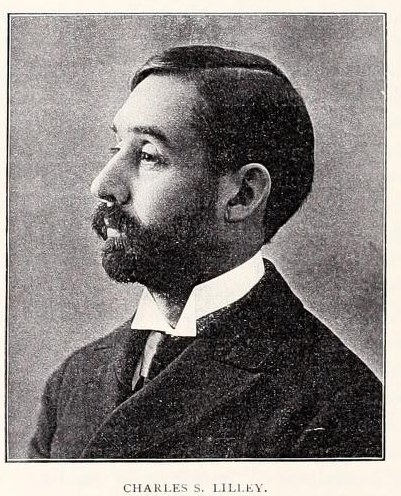
From Memoirs of the Judiciary and the Bar of New England, 1900. Lawyer, state senator, Superior Court judge 1893–1900, later president of this very cemetery, and the man who commissioned this memorial in 1899. He raised his daughter in the house, gave her away there in 1917, and his funeral was held there in 1921.[sources]

Do not confuse Clara with her daughter, also named Clara Bonney Lilley (born 1894), who married Philip R. Dunbar in 1917 and sold the house in 1925. Her story is here.
The memorial as art
What a visitor sees is two things made at different scales: a bronze figure, and the granite architecture that frames it — fluted columns, a plain entablature, a rear panel for the inscription. The figure is a draped woman, head turned upward, arms raised to hold a length of cloth that falls behind and around her. The bronze has weathered to the green of a century outdoors.
The records now agree on who made it. Lorado Taft’s History of American Sculpture (1903) lists among the works of Frank Edwin Elwell — later curator of sculpture at the Metropolitan Museum — “New Life, Lowell cemetery, property of Hon. Charles Sumner Lilley, called the Bonney Memorial, 1899”. The American Architect and Building News of 5 January 1901 published it as “The Bonney Memorial, Lowell Cemetery — Brite & Bacon, Architects; Mr. F. E. Elwell, Sculptor”. So: a bronze titled New Life, commissioned by Judge Lilley in 1899, five years after his wife’s death, in a granite surround by the New York architects Brite & Bacon.[source]
Lowell Cemetery’s own notable-monuments page calls the figure Victoria, the classical personification of victory over death — a reasonable reading of the raised arms and the drape, but a description, not the title — and prints Clara’s dates as 1845–1884, which the inscription contradicts. The Pollard Memorial Library’s account has the sculptor and title right and names the architect as “Frank Bacon”. Elwell also made a second work for the family, Genius of Memory, the Lilley memorial elsewhere in the cemetery.[sources]
Whether the figure was meant to resemble Clara, or anyone, is not known. Nothing in the records seen calls it a portrait; the title Elwell gave it is an idea, not a name.


Legend and record
Two summaries, side by side. Both are in the ordinary flow of the page; nothing is hidden behind a reveal.
The legend says
- A witch, or a mill girl, lies here.
- She was condemned at Salem.
- Her dress falls each Halloween and she walks.
- Devices fail near the grave.
- The lion guards her.
The record says
- A lawyer, his wife, their daughter and her husband lie here — a prominent nineteenth-century Belvidere family.[source]
- The Salem trials were in 1692; the eldest person here was born in 1828; the cemetery dates from 1841.
- The figure is a fixed bronze casting; the drape is part of it.
- Reported failures are uncorroborated anecdotes.
- The Ayer lion is a separate family’s monument some distance away.
| Claim | Evidence | What we can say |
|---|---|---|
| The family lived at 236 Fairmount Street | Deed of 1887; Bonney’s 1896 obituary (“his home on Fairmount street”); Lilley’s 1921 funeral “at the late home, 236 Fairmount street”; 1915–16 tax lists | Documented. Arthur, Emma and Charles lived and died in the house; Clara grew up in it and was married in it. |
| Clara died young, after childbirth | Lowell Sun, July 1894: “long and painful illness”; “an infant daughter survives her”; monument: 19 July 1894; daughter born April 1894 | Documented that she died at 39, three months after her daughter’s birth. Cause of death (pyaemia, per modern accounts citing the certificate) not yet checked by us; no causal link to childbirth is asserted. |
| The surviving child | Sun 1894 and 1896; wedding notice 1917; deed 1925 | Documented. Clara Bonney Lilley (1894–) inherited and sold the house. Accounts saying the couple had no children are wrong. |
| Who made the monument, and when | Taft, History of American Sculpture (1903): Elwell, “New Life”, “Bonney Memorial”, 1899; American Architect, 5 Jan 1901: Brite & Bacon, architects | Documented. Commissioned by Judge Lilley; made 1899; published 1901. The cemetery’s “Victoria” is a later description. |
| A portrait of Clara | No record | Unknown. Treated as an allegorical figure until evidence appears. |
| A witch | Modern web accounts only | Folklore. The witch-trial narrative is impossible on the dates and is not an explanation of anyone’s life. |
How stories change
The earliest dated account of the legend found so far is from 2009. Each later telling adds something — the Salem families, the roaming, the lion, the batteries. Published accounts show that a story is in circulation; they do not show when or how it started. If an earlier printed version exists (a 1970s or 1980s Halloween feature in the Lowell Sun, say), it has not yet been found. Until it is, the origin of the Witch Bonney is simply unknown, and this page does not guess at it — nor does it claim that any one tragedy in the family produced the legend.[source]
Continue the story
- The Bonney and Lilley years on the timeline
- The people of the house
- The history of the house
- Lowell Cemetery: visiting
Have a dated recollection of the legend, or a documentary lead? Write to us. Nothing is published automatically.
Sources for this page
- Monument inscription, Bonney lot, Lowell Cemetery — photographed by the owner, 21 March 2020 (record).
- Lorado Taft, The History of American Sculpture (1903), p. 411; American Architect and Building News, 5 Jan 1901; Elwell’s list of works (records).
- Memoirs of the Judiciary and the Bar of New England (1900), vol. 1, pp. 121–122, with the portrait of Judge Lilley (record).
- The Lowell Sun, 23 Nov 1893; 19–21 Jul 1894; 26 and 30 Mar 1896; 7 Jun 1917; 18 and 20 Apr 1921 — digitised at the Internet Archive (records).
- Pollard Memorial Library, “Those buried under the ‘Witch Bonney’ monument”, 25 Oct 2023 (lowelllibrary.org). Institutional secondary account with its own citations; a few slips noted in the record.
- Ryan W. Owen, “The Real Ghost Story Behind Lowell Cemetery’s Witch Bonney”, Forgotten New England, 18 Oct 2020 (forgottennewengland.com). Attributed modern narrative; quoted for the legend, not for motives.
- Atlas Obscura, “Mysterious Witch Bonney”, 16 Jun 2009 (atlasobscura.com). Community account; directions to the lot.
- Lowell Cemetery, “Notable Monuments” (lowellcemetery.com), accessed 11 Oct 2026.
- Research notes C-010, C-011, C-014, C-045–C-051 and C-053 on the Sources page.
Photographs on this page are the owner’s own. Text is original to this site; nothing is reproduced from the articles above beyond short attributed quotations.